

Part I — Intelligence Isn’t Always Analytical
For years now, much of the conversation around Donald Trump has been built on a simple assumption: he’s dumb.
People point to how he talks, the repetition, the exaggeration, the lack of polish, and conclude that he must not really understand what he’s doing.
But that explanation doesn’t hold up very well.
Whatever else one thinks about Trump, he has occupied the presidency twice and has clearly shifted how America behaves at home and abroad. That doesn’t happen by accident.
So perhaps the more useful question isn’t whether he’s “smart” in the traditional sense, but what kind of intelligence actually matters in politics.
Trump doesn’t come across as a policy builder. He doesn’t seem especially interested in the technical details of governance. He’s not someone who wants to sit in a room and wrestle with institutional process or long-term structural planning.
But he does show a strong instinct for something else.
He understands attention.
He understands conflict.
He understands how people interpret strength and weakness.
Most of the time, he doesn’t construct policy from the ground up. Instead, he sets direction.
Something like: we need to be tougher on China, we need better trade terms, we need to assert ourselves more globally.
From there, the machinery of government, advisors, agencies, policy teams, translates that direction into specific actions.
In that sense, Trump often functions less as the architect and more as the force that sets the agenda. He moves the center of gravity, and others figure out how to operationalize it.
That’s not entirely unique to him. Every president relies on teams. But with Trump, the gap between instinct and execution is wider than usual.
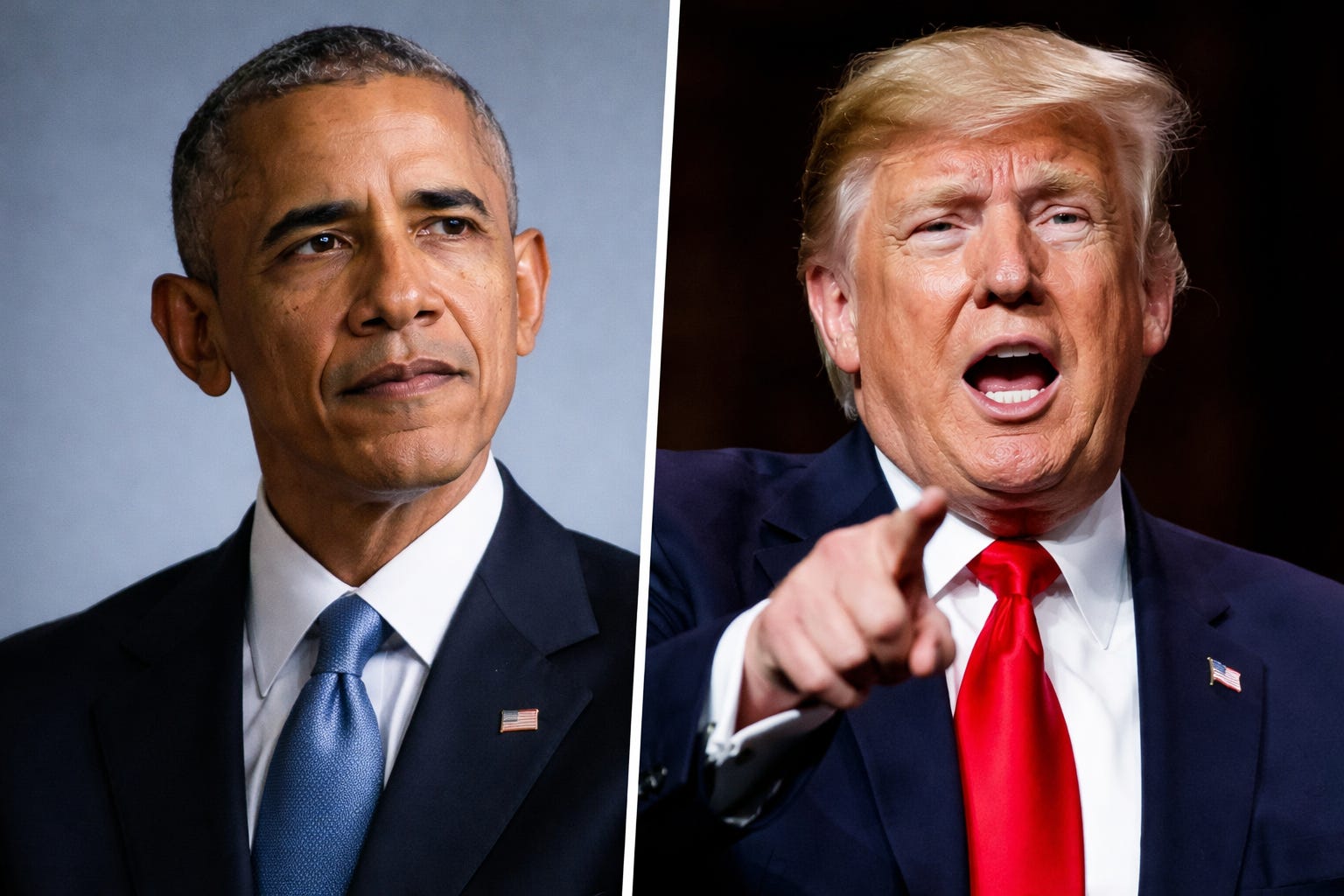
Which is what makes the contrast with Barack Obama so striking.
Obama was almost the mirror image.
He was analytical, precise, deeply comfortable with institutions and process. He tended to build arguments from logic upward. Where Trump simplifies, Obama explained. Where Trump disrupts, Obama deliberated.
And yet both inspired strong loyalty.
Both reshaped coalitions.
Both changed how America showed up in the world.
Obama’s authority came from intellectual coherence. He persuaded the system.
Trump’s authority comes from emotional clarity. He pressures the system.
Obama trusted process to produce outcomes.
Trump challenges process to create leverage.
One led through mastery of complexity.
The other leads through rejection of it.
Which raises a deeper question.
If Trump isn’t operating through analysis, but through instinct, and still proving consequential, what does that say about how power actually works?

Part II — Understanding Isn’t the Same as Endorsing
There’s also a tension embedded in this conversation.
Many people who recognize the effectiveness of Trump’s leadership style still feel deeply uneasy about it.
Some of the concerns often raised on the conservative side, such as border structure, immigration policy, and fiscal discipline, resonate across political lines.
At the same time, there are positions and behaviors that create real discomfort. These include the blending of religion and policy, resistance to gun regulation, the brutal treatment of those cast as illegals and the perception that public office can be used for personal enrichment.
That last issue, in particular, challenges the idea that leadership should serve something larger than individual gain.
Still, part of what makes Trump so consequential is that he reflects something we often prefer not to confront.
In business, politics, and life, those most willing to push boundaries, those who operate at the edge of what’s acceptable, often gain the greatest advantage.
Not because they are morally better.
But because they are less internally constrained.
Trump has spent much of his career operating in that gray zone between what is clearly legal and what is merely tolerated. It’s how he built his success, and it is clearly how he approaches power.
In some ways, that instinct scales when applied to national leadership.
For those who believe strongly in the aspirational story of America, fairness, equal rules, legitimacy, this can feel jarring.
Because it suggests that effectiveness and virtue don’t always travel together.
Understanding this doesn’t make the approach admirable.
And it doesn’t resolve the tension.
It simply raises a harder question.
Can leadership styles that feel personally troubling still produce outcomes that are broadly valued?
That question is uncomfortable.
But it sits at the intersection of idealism and reality.
Recognizing influence does not require admiration.
And acknowledging results does not erase concern.
It simply forces a more honest reckoning with the possibility that power in the modern world may still flow most readily to those willing to wield it without hesitation.
Author’s Note
I share reflections like this as part of an ongoing effort to better understand the world, and my own place within it. These are not declarations of certainty, but attempts to wrestle honestly with complexity.
The goal is not to land on perfect answers, but to think more clearly, listen more openly, and grow through dialogue.
If this resonates, or challenges you, I welcome your perspective. Real understanding often begins in discomfort.